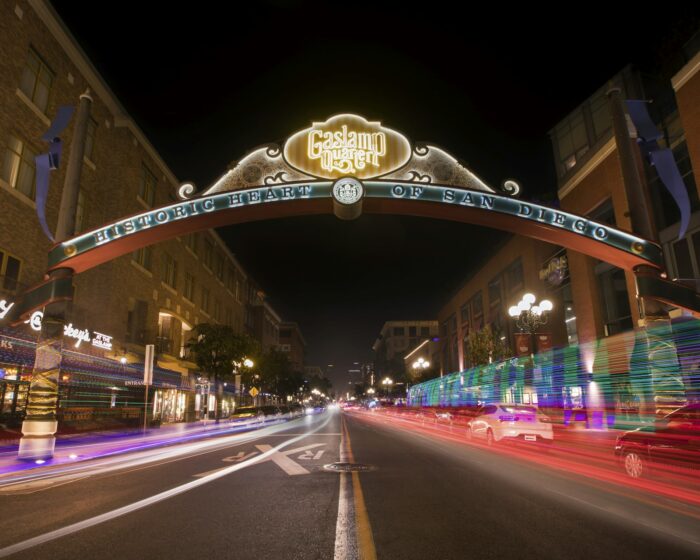
Quick answer: Yes, Wyatt Earp lived in San Diego. The famous lawman of the O.K. Corral arrived during the city’s real estate boom in the mid-1880s and stayed for several years, possibly into the 1890s. He made his money as a gambler and saloon operator in what is now the Gaslamp Quarter. At the time it was called the Stingaree, the city’s rough-and-tumble vice district.
Most visitors know Earp from Tombstone. Fewer know that he spent some of his most profitable years a few blocks from today’s rooftop bars. Here’s what the records show, where the legends take over, and where you can still stand on the same streets.
Why did Wyatt Earp come to San Diego?
For the money. In the mid-1880s, San Diego was in the middle of a land boom. Railroad connections were bringing in speculators, and the population grew fast. Earp left Arizona after the 1881 gunfight at the O.K. Corral and the vendetta that followed. He came to San Diego with his companion, Josephine “Sadie” Marcus, who stayed with him until his death in 1929. According to the Gaslamp Quarter Historical Foundation, an 1887 city directory listed him as a “capitalist.” In practice, that meant gambler.
What did Wyatt Earp do in San Diego?
Earp is credited with running four saloons and gambling halls in and around the Stingaree. They offered faro, poker, blackjack and other games. Accounts say that at the height of the boom, his tables could clear as much as $1,000 in a single night. He also dabbled in real estate and followed horse racing. By several accounts he won a racehorse at the tables.
Tour-guide honesty note: Historians agree on the broad picture: Earp was here, he gambled, and he ran gaming halls. The details are less settled. Exactly which buildings he leased, and the exact dates he arrived and left, vary from source to source. So do the dollar figures, which come from stories told later.
The Oyster Bar at the Louis Bank of Commerce
The building most connected to Earp is the Louis Bank of Commerce at 835–837 Fifth Avenue. It’s a granite building with twin towers from the late 1880s. After the bank moved out in 1893, the ground floor became the Oyster Bar. Sources describe it as a favorite hangout of Earp’s, and some say he ran it. Upstairs, according to local lore, was a brothel called the Golden Poppy, where each room was painted a different color.
Today you can stand across Fifth Avenue and picture it. Just look up past the modern storefronts to the towers.
Where did Wyatt Earp live in San Diego?
According to the Horton Grand Hotel and the Gaslamp Quarter Historical Foundation, Earp lived at a hotel that is now part of the Horton Grand Hotel at Fourth Avenue and Island Avenue. The building has an unusual history. The Horton Grand is actually two 1880s hotels, the Grand Horton and the Brooklyn-Kahle Saddlery Hotel. In the late 1970s both were taken apart brick by brick to make way for the Horton Plaza development, then rebuilt side by side a few blocks away. It reopened in 1986. So the rooms Earp knew are there, but not on their original lot.
What was the Stingaree?
The Stingaree was San Diego’s red-light district. It covered roughly the blocks south of Market Street between First and Fifth Avenues, which is today’s southern Gaslamp and East Village edge. It was full of saloons, gambling halls, opium dens and brothels. One popular explanation for the name is that you were as likely to get “stung” there as by a stingray in the bay.
The district outlasted Earp by more than a decade. Its best-known madam, Ida Bailey, ran the Canary Cottage from the early 1900s. According to the Horton Grand, it stood on or near the site of the hotel’s restaurant today. The end came on November 10, 1912. Police raided the district and arrested 138 women on vagrancy charges. A judge suspended their fines on the condition that they leave town on the afternoon train. Most of them bought tickets to Los Angeles.
We cover the Stingaree’s darker side, including the murders, the police payoffs and the ghost stories, on our Gaslamp Ghosts and Crime Walking Tour.
When did Wyatt Earp leave San Diego?
There’s no single documented departure date. The San Diego boom collapsed around 1888–89, and Earp’s fortunes moved with it. He spent the 1890s moving around the West, including San Francisco, and later went to Alaska during the Klondike-era gold rushes. The Gaslamp Quarter Historical Foundation notes that he may have kept ties to San Diego until about 1896. He died in Los Angeles in 1929.
A self-guided Wyatt Earp walk in the Gaslamp
You can trace Earp’s San Diego in about 30 minutes:
- Horton Plaza Park (Broadway & Fourth): the northern edge of the old commercial district and a good starting point.
- Louis Bank of Commerce (835–837 Fifth Ave.): home of the Oyster Bar.
- Fifth Avenue south of Market: the heart of the old Stingaree. Imagine it lined with saloons and gaming halls.
- Horton Grand Hotel (Fourth & Island): where Earp is said to have lived.
- Davis-Horton House (410 Island Ave.): the 1850 house that is now the Gaslamp Museum.
Want the full story, told on the corners where it happened? Our Gaslamp Quarter History Walking Tour covers Earp’s gambling halls, the Oyster Bar, Ida Bailey’s Canary Cottage and the 1912 raid. It’s a relaxed, small-group walk that starts at Horton Plaza Park.
Frequently asked questions
Did Wyatt Earp live in the Gaslamp Quarter?
Yes. Earp lived in San Diego from the mid-1880s, possibly into the 1890s. He ran gambling halls in the area now called the Gaslamp Quarter and, by most accounts, lived in a hotel that is now part of the Horton Grand Hotel.
What was Wyatt Earp’s saloon in San Diego called?
The name most often linked to Earp is the Oyster Bar, in the Louis Bank of Commerce building at 835–837 Fifth Avenue. He is credited with running four saloons and gambling halls in total, but the names and locations of the others are less well documented.
Can you visit Wyatt Earp sites in San Diego?
Yes. The Louis Bank of Commerce and the Horton Grand Hotel are both still standing in the Gaslamp Quarter and can be seen from the street. The Horton Grand is still an operating hotel. Guided history tours of the Gaslamp typically include both.
How long was Wyatt Earp in San Diego?
Estimates range from a few years to about a decade. Most sources place his arrival between 1885 and 1887, during the land boom. Some suggest he kept a presence in the city until around 1896.
Walk in Wyatt Earp’s footsteps. Book the Gaslamp Quarter History Walking Tour or see all our tours.
Sources include the Gaslamp Quarter Historical Foundation, the Horton Grand Hotel, and the Journal of San Diego History (“When the Red Lights Went Out in San Diego,” 1974).